CSA Z462 Arc Flash Training – Electrical Safety Compliance Course
Our customized live online or in‑person group training can be delivered to your staff at your location.

- Live Online
- 6 hours Instructor-led
- Group Training Available
Regular Price:
$249
Coupon Price:
$199
LOS ANGELES
—
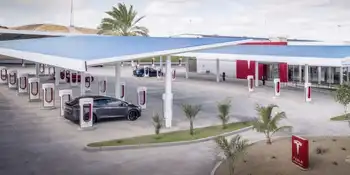
Tesla Supercharger Billing Update details kWh-based pricing that now includes HVAC, battery thermal management, and other HV loads during charging sessions, improving cost transparency across pay-per-use markets and extreme climate scenarios.
Key Information
Tesla's update bills for kWh used by HVAC, battery heating, and HV loads during charging, reflecting true energy costs.
Includes HVAC, battery heating, and other vehicle HV consumption
Increases transparency of total electricity costs per session
Impacts pay-per-use markets; time-based regions unchanged
Users in extreme climates may see 10-25 kWh higher bills
Calls for clearer session cost breakdowns in Tesla app
Tesla has updated its Supercharger billing policy to add the cost of electricity use for things other than charging, like HVAC, battery thermal management, etc, while charging at a Supercharger station, a shift that impacts overall EV charging costs for drivers.
For a long time, Tesla’s Superchargers were free to use, or rather the use was included in the price of its vehicles. But the automaker has been moving to a pay-to-use model over the last two years in order to finance the growth of the charging network amid the Biden-era charging expansion in the United States.
Not charging owners for the electricity enabled Tesla to wait on developing a payment system for its Supercharger network.
It didn’t need one for the first five years of the network, and now the automaker has been fine-tuning its approach to charge owners for the electricity they consume as part of building better charging networks across markets.
At first, it meant fluctuating prices, and now Tesla is also adjusting how it calculates the total power consumption.
Last weekend, Tesla sent a memo to its staff to inform them that they are updating the calculation used to bill Supercharging sessions in order to take into account all the electricity used:
The calculation used to bill for Supercharging has been updated. Owners will also be billed for kWhs consumed by the car going toward the HVAC system, battery heater, and other HV loads during the session. Previously, owners were only billed for the energy used to charge the battery during the charging session.
Tesla says that the new method should more “accurately reflect the value delivered to the customer and the cost incurred by Tesla,” which mirrors recent moves in its solar and home battery pricing strategy as well.
The automaker says that customers in “extreme climates” could see a difference of 10 to 25 kWh for the energy consumed during a charging session:
Owners may see a noticeable increase in billed kWh if they are using energy-consuming features while charging, e.g., air conditioning, heating etc. This is more likely in extreme climates and could be a 10-25 kWh difference from what a customer experienced previously, as states like California explore grid-stability uses for EVs during peak events.
Of course, this is applicable where Tesla is able to charge by the kWh for charging sessions. In some markets, regulations push Tesla to charge by the minute amid ongoing fights over charging control between utilities and private operators.
Electrek’s Take
It actually looks like an oversight from Tesla in the first place. It’s fair to charge for the total electricity used during a session, and not just what was used to charge your battery pack, since Tesla is paying for both, even as some states add EV ownership fees like the Texas EV fee that further shape costs.
However, I wish Tesla would have a clearer way to break down the charging sessions and their costs.
There have been some complaints about Tesla wrongly billing owners for charging sessions, and this is bound to create more confusion if people see a difference between the kWhs gained during charging and what is shown on the bill.
Related News
Related News
Philippines Ranks Highest in Coal-Generated Power Dependency
Philippines coal dependency underscores energy transition challenges, climate change risks, and air pollution, as rising…
View more
Electric Motor Testing Training
Electric Motor Testing Training covers on-line and off-line diagnostics, predictive maintenance, condition monitoring, failure analysis,…
View more
Greening Ontario's electricity grid would cost $400 billion: report
Ontario Electricity Grid Decarbonization outlines the IESO's net-zero pathway: $400B investment, nuclear expansion, renewables, hydrogen,…
View more
Why subsidies for electric cars are a bad idea for Canada
EV Subsidies in Canada influence greenhouse-gas emissions based on electricity grid mix; in Ontario and…
View more
Should California Fund Biofuels or Electric Vehicles?
California Biofuels vs EV Subsidies examines tradeoffs in decarbonization, greenhouse gas reductions, clean energy deployment,…
View more
Africa's Electricity Unlikely To Go Green This Decade
Africa 2030 Energy Mix Forecast finds electricity generation doubling, with fossil fuels dominant, non-hydro renewables…
View more
Sign Up for Electricity Forum’s Newsletter
Stay informed with our FREE Newsletter — get the latest news, breakthrough technologies, and expert insights, delivered straight to your inbox.
Electricity Today T&D Magazine Subscribe for FREE

Stay informed with the latest T&D policies and technologies.
- Timely insights from industry experts
- Practical solutions T&D engineers
- Free access to every issue

