Electrical Fuse Box vs Circuit Breaker - Failure Risks
By William Conklin, Associate Editor
By William Conklin, Associate Editor
Our customized live online or in‑person group training can be delivered to your staff at your location.
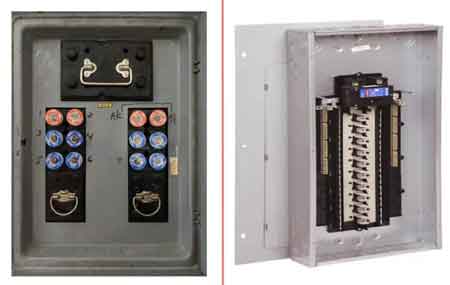
An electrical fuse box and a circuit breaker panel interrupt faults differently, shaping safety exposure, maintenance risk, upgrade limits, and long-term reliability. The wrong choice can quietly turn minor overloads into recurring outages or hidden electrical hazards.
Although both stop fault current, they behave very differently once something goes wrong. Problems rarely announce themselves all at once. They accumulate through nuisance outages, unsafe substitutions, and system limits that only become obvious when loads change or failures repeat.
That is why this comparison still matters long after the first blown fuse or tripped breaker.
Most comparisons stop at the obvious point: fuses melt and must be replaced, breakers trip and can be reset. That difference is real, but it is incomplete. What matters more is what happens around the fault, not just during it.
A fuse removes energy decisively, but it also removes context. Once it opens, the system gives no information about why it failed, whether the fault was transient, or whether the circuit was misused. The next step is entirely human, and it is there that risk accumulates. Replacing a blown fuse with one of a higher rating is a common field shortcut, and it quietly defeats the very protection the fuse was meant to provide. That risk does not exist on paper, but it exists in real buildings.
Circuit breakers behave differently. A tripped breaker preserves the evidence of a problem. It invites investigation rather than substitution, and it reduces the temptation to “solve” the issue by oversizing protection. That difference alone explains why breaker panels integrate more predictably into modern circuit protection devices strategies.
Stay informed with our FREE Electrical Protection Newsletter — get the latest news, breakthrough technologies, and expert insights, delivered straight to your inbox.
Fuse systems assume correct human behavior every time a fault occurs. That assumption rarely holds indefinitely. Over years of ownership, the odds of incorrect replacement rise, especially in facilities where spare fuses are mismatched, undocumented, or sourced ad hoc.
Breaker panels shift that burden away from replacement and toward diagnosis. When faults repeat, the breaker becomes a signal rather than a consumable. That is one reason breaker-based systems support layered protection, such as overcurrent protection and selective coordination, in ways fuse boxes simply cannot.
This is not about convenience. It is about whether the system encourages safe decisions under pressure.
Many fuse boxes were installed when electrical demand was modest and predictable. Today’s loads are neither. Portable heaters, EV chargers, power electronics, and sensitive equipment push systems to the limit, often without the owner realizing it.
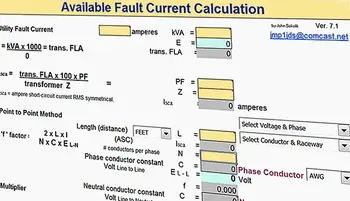
Fuse panels offer little margin when loads evolve. They lack the feedback mechanisms that modern protection schemes rely on, and they do not pair well with downstream devices that depend on known fault behavior. Breaker panels, by contrast, are designed to coexist with fault calculations, coordination studies, and measured values such as available fault current.
When systems are upgraded incrementally, this difference becomes decisive.
The fuse-versus-breaker decision is often framed as old versus new. That framing misses the real issue. The question is whether the panel can participate in a coherent protection strategy.
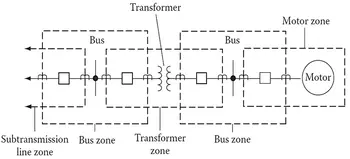
Breaker panels integrate naturally into broader power system protection planning. They support devices that respond differently to overloads, short circuits, and arc faults, including arc-fault interrupter breakers and ground-fault schemes. Fuse boxes largely stand apart from that ecosystem.
Once a system needs coordination, monitoring, or a layered response, the fuse box becomes an obstacle rather than a safeguard.
It is true that fuse boxes appear cheaper at first glance. Fuses cost little, and the panels are already installed. But lifecycle cost tells a different story.
Repeated outages, misdiagnosed faults, equipment damage from improper protection, and insurance scrutiny all add cost without appearing on an invoice. Breaker panels front-load expense but reduce uncertainty. They also align with how protection is evaluated in commercial and industrial contexts, where fault behavior, not component price, drives decisions.
This same logic is why protection discussions extend beyond panels into areas such as transformer overcurrent protection, even in systems that appear simple on the surface.
There are limited cases where a fuse box remains serviceable. Very low-demand installations with stable loads and controlled maintenance can function without immediate hazard. In those cases, the decision is less about urgency and more about awareness.
What matters is recognizing that the system is static in a world that is not. The moment loads change, tenants rotate, or upgrades are planned, the decision must be revisited with clearer eyes.
Choosing between an electrical fuse box and a circuit breaker panel is ultimately a choice between two philosophies of protection. One relies on consumables and correct human intervention. The other relies on repeatable behavior, visibility, and integration.
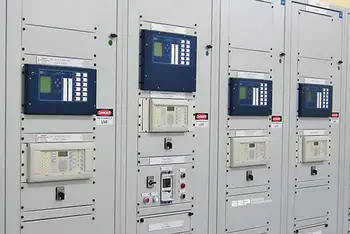
That distinction explains why modern electrical protection frameworks, including those that involve relays, coordination, and system-level planning, are built around breakers rather than fuses. It is not because fuses “don’t work.” It is because predictability matters more than simplicity when systems evolve.

Explore 50+ live, expert-led electrical training courses –