DC Voltage Drop Calculation
By Harold Williams, Associate Editor
By Harold Williams, Associate Editor
Our customized live online or in‑person group training can be delivered to your staff at your location.

dc voltage drop calculation uses a step-by-step method to determine voltage loss in a direct current circuit using current, conductor resistance, and total circuit length to ensure proper voltage at the load in battery systems, low-voltage installations, and long cable runs.
DC voltage drop calculation applies only to direct current circuits where current flows in one direction. It is used in battery systems, DC control circuits, and low-voltage power installations. This calculation does not apply to AC systems, impedance-based conditions, or three-phase power.
The purpose of this calculation is to verify that the voltage delivered at the load remains within acceptable limits after conductor losses are considered.
DC voltage drop calculation follows a fixed step-by-step procedure using actual circuit values.
Step 1. Identify system voltage
Determine the nominal DC system voltage. Common values include 12V, 24V, and 48V in battery-based systems and low-voltage installations.
Step 2. Determine circuit current
Establish the load current in amperes. This is the current flowing through the conductor during normal operation.
Step 3. Measure total circuit length
Measure the full conductor path from the source to the load and back to the source. Both the outgoing and return conductors must be included.
Total length = one-way distance × 2
Step 4. Determine conductor resistance
Obtain the resistance value of the conductor based on its material and size using standard conductor tables or manufacturer data.
Step 5. Calculate voltage drop
Apply the calculation using circuit current and total conductor resistance.
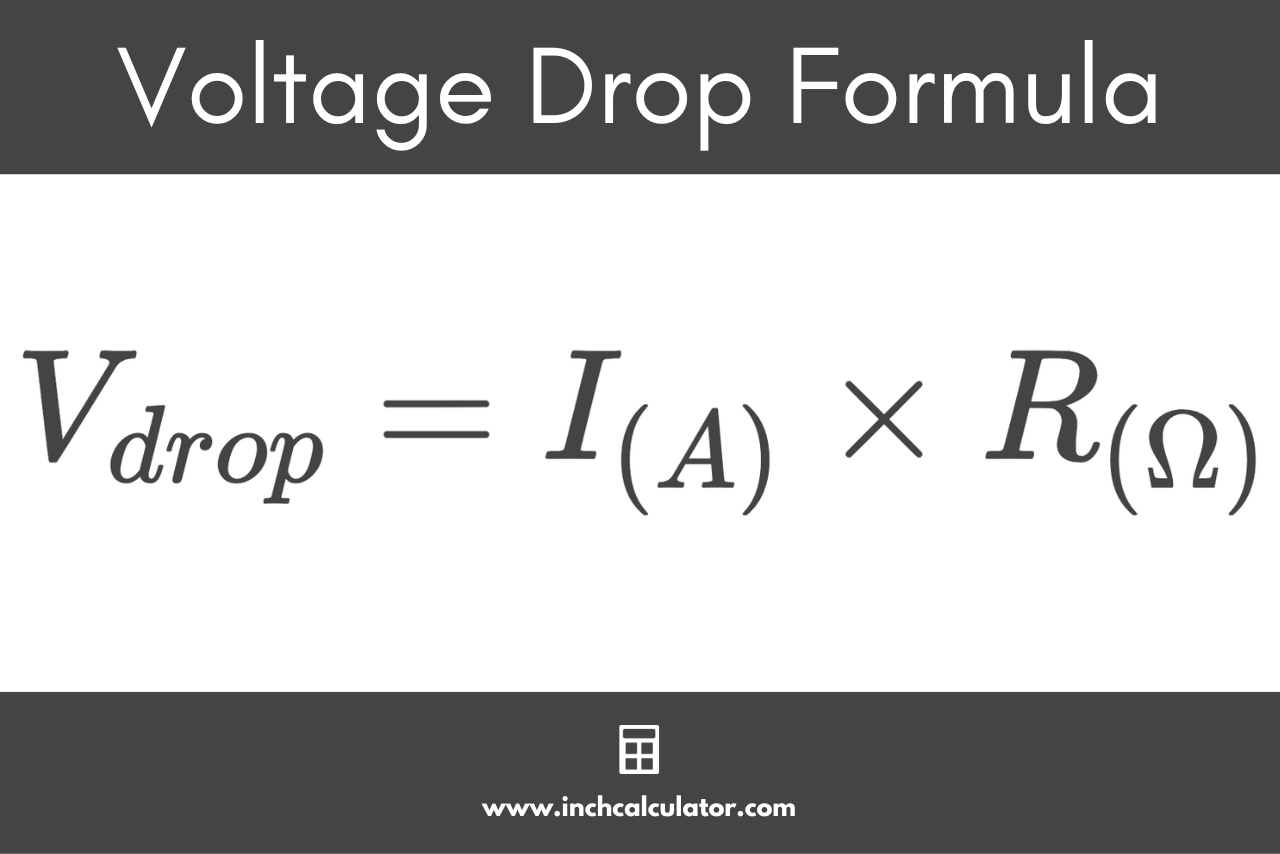
Voltage drop = current × resistance
This calculation uses the standard relationship between current and resistance as defined in Voltage Drop Formula.
Step 6. Calculate the percentage voltage drop
Compare the calculated voltage drop to the system voltage.
Percentage voltage drop = (voltage drop ÷ system voltage) × 100
Download our FREE Electrical Training Catalog and explore a full range of expert-led electrical training courses.

This result determines whether the voltage loss is acceptable for the application.
This procedure is used to size conductors and verify that the voltage at the load remains within acceptable limits before installation.
Battery systems operate at relatively low voltages, making them sensitive to conductor losses. Even small resistance values can produce a measurable voltage reduction that affects equipment performance.
In 12V and 24V systems, voltage drop must be controlled to maintain proper operation of connected devices. Long cable runs between battery banks and loads increase resistance and increase voltage loss.
Low-voltage DC circuits used in control wiring, telecommunications, and electronic systems require stable voltage at the load. Small voltage reductions can affect control signals, relay operation, and system reliability.
Applying the calculation ensures that conductor sizing supports consistent voltage delivery under normal load conditions.
As conductor length increases, resistance increases proportionally. Long cable runs are a common cause of excessive voltage drop in DC systems.
When the calculated voltage drop exceeds acceptable limits, corrective action is required. This typically involves increasing conductor size or reducing circuit length where possible.
For quick validation of conductor size, length, and current conditions, results can be compared using the Voltage Drop Calculator.
The calculated result must be evaluated against acceptable design limits. If voltage drop is too high, the load will receive reduced voltage and may not operate correctly.
Corrective actions include increasing conductor size, reducing current, or shortening the conductor path. These adjustments reduce resistance or current and lower the resulting voltage drop.
The resulting voltage reduction under load conditions can contribute to performance issues similar to those described in Voltage Dropping.
Accurate DC voltage drop calculation ensures that battery systems, low-voltage installations, and long conductor runs deliver sufficient voltage for reliable operation.

Explore 50+ live, expert-led electrical training courses –