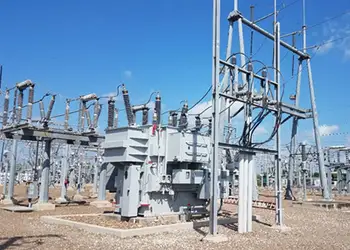
Substation Relay Protection Training
Our customized live online or in‑person group training can be delivered to your staff at your location.
- Live Online
- 12 hours Instructor-led
- Group Training Available
Regular Price:
$699
Coupon Price:
$599
A team led by Professor Daniel Kwok and Professor Larry Kostiuk from the University of Alberta, Edmonton, Canada, has developed the first new way to generate electricity since 1839.
"Despite the importance of electrical power in modern society, there are limited methods of converting energy to electricity. Common ways to create electricity include electromagnetic induction that converts the work applied to a conductor being forced through a magnetic field (Faraday, 1831), fuel cells that draw on materials' chemical energy (Grove, 1839), and photovoltaics that use electromagnetic radiation (Becquerel, 1839). This new method of directly converting the energy associated with a liquid (e.g. water) could introduce a revolution in electricity production." wrote Professor Kostiuk in a summary provided to journalists.
In research published on the 20th of October, 2003, in the Institute of Physics journal, Journal of Micromechanics and Microengineering, Kwok, Kostiuk and their collaborators describe a method of generating electrical power from the natural electrokinetic properties of fluids forced through microchannels.
The electricity is generated by separating electrical charges in the fluid at a solid-fluid interface. When the solid is in contact with the fluid, some of the atoms in the solid disassociate - forming negative, free, electrons and positive ions. Depending on the type of solid, one or the other of these will flow off into the fluid, leaving the solid with a net charge. Ideally the solid is not a conductor, so this charge is localized at the solid-fluid interface rather than being diluted through out the solid. This charge then attracts oppositely charged ions and repels similarly charged ions in the fluid. This forms a thin layer (known as the Electric Double Layer or EDL) in the fluid (between nanometers and micrometers in thickness) that is charged. When the attracted ions approach the surface, they can accept or donate charge to neutralize the surface but an equilibrium is quickly reached between the disassociation that creates the charge and the charge nullification effects of the ions.
By making fluid flow through narrow channels with a diameter similar to the EDL, the attracted type of ion will be able to flow through the EDL filled channel with ease, while the other sign is largely rejected. In the figure, you can see a positive solid creating a negatively charged EDL in the channel. Neutral water can flow through this layer, and when a negatively charged ion enters from the left, the mutual repulsion between the ions pushes one out from the right hand end, but when a positive ion flows towards the channel, the positive solid prevents it from entering the channel as this repulsion overwhelms the attraction due tot he negative ions in the EDL.
This flow leads to a separation of charges on either side of the channel, which creates a voltage between the two ends. If an object, like a cell phone, is connected between the two ends, a current will flow that can be used to power the device. Although the power generated from a single channel is extremely small, millions of parallel channels can be used in a small volume to increase the power output to useful levels.
Speaking to the IOP press office, Professor Kostiuk said: "This discovery has a huge number of possible applications. It's possible that it could be a new alternative energy source to rival wind and solar power, but this would need huge bodies of water to work on a commercial scale. Hydrocarbon fuels are still the best source of energy but they're fast running out and so new options like this one could be vital in the future.
"The applications in electronics and microelectronic devices are very exciting. This technology could provide a new power source for devices such as mobile phones or calculators which could be charged up by pumping water to high pressure. What we have achieved so far is to show that electrical power can be directly generated from flowing liquids in microchannels".
It is possible to make a (relatively) simple device that works similarly to this at home or in the class room - the Kelvin Water Dropper which uses electrical repulsion to separate charge in a very similar manner.
Related News

California faces huge power cuts as wildfires rage
California Wildfire Power Shut-Offs escalate as PG&E imposes blackouts amid high winds, Getty and Kincade…
View more

Key Ontario power system staff may end up locked down at work sites due to COVID-19, operator says
Ontario IESO COVID-19 Control Room Measures detail how essential operators safeguard the electricity grid with…
View more
Restrict price charged for gas and electricity - British MPs
UK Energy Price Cap aims to protect consumers on gas and electricity bills, tackling Big…
View more
Electricity Regulation With Equity & Justice For All
Energy equity in utility regulation prioritizes fair rates, clean energy access, and DERs, addressing fixed…
View more
Ontario's electricity 'recovery rate' could lead to higher hydro bills
Ontario Hydro Flat Rate sets a single electricity rate at 12.8 cents per kWh, replacing…
View more

B.C. residents and businesses get break on electricity bills for three months
BC Hydro COVID-19 Bill Relief offers pandemic support with bill credits, rate cuts, and deferred…
View more
Sign Up for Electricity Forum’s Newsletter
Stay informed with our FREE Newsletter — get the latest news, breakthrough technologies, and expert insights, delivered straight to your inbox.
Electricity Today T&D Magazine Subscribe for FREE

Stay informed with the latest T&D policies and technologies.
- Timely insights from industry experts
- Practical solutions T&D engineers
- Free access to every issue

