Protective Relay Training - Basic
Our customized live online or in‑person group training can be delivered to your staff at your location.
- Live Online
- 12 hours Instructor-led
- Group Training Available
Regular Price:
$699
Coupon Price:
$599
Cadmium Telluride vs Uranium Energy Density highlights thin-film solar PV material efficiency per kWh, lifecycle output, recyclability, and resource intensity, contrasting uranium fuel burn and coal inputs for sustainable, low-emissions electricity generation.
At a Glance
A comparison of material per kWh: CdTe PV needs ~10x less than uranium fuel, endures 30 years, and is recyclable.
- CdTe PV uses ~0.0026 g per kWh across a 30-year lifetime
- Uranium fuel needs ~10x more mass per kWh than CdTe PV
- Coal mass per kWh dwarfs CdTe by ~200,000x or more
- PV modules generate power for decades; fuel is not burned
A novel way of comparing solar power with nuclear power finds that solar easily bests nuclear.
Ken Zweibel has an analysis at The Solar Review that compares the two kinds of electrical energy, in terms of how much power is packed into each gram of its respective material: cadmium telluride, versus uranium.
He provides data showing that CdTe thin film solar power using cadmium telluride, alongside cutting solar costs trends seen across the industry today, takes ten times less PV material to make 1 kilowatt hour of electricity, than nuclear uses of uranium, to make an identical 1 kilowatt hour of electricity.
This is even comparing the two as if solar "used up" each gram of cadmium telluride the way that nuclear power uses up its uranium fuel pretty much — some can be recycled, theoretically. But of course, solar doesn't burn up fuel. You can get electricity from the same grams of PV material for at least thirty years, and then the material can be recycled and still used again, with glitter-sized PV concepts promising even greater flexibility later.
By contrast, the equivalent grams of nuclear uranium must be replaced with newly mined uranium once the first has yielded its energy.
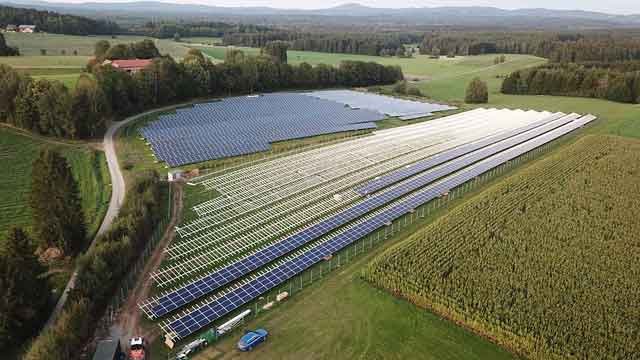
Here's his math. It takes 12 grams of CdTe to make a one square meter solar thin film module, and innovations like cylindrical solar cells illustrate alternate thin-film designs as well.
"In a year in an average U.S. location, we harvest about 11 x 1750 kWh/m2-yr, or 154 kWh/yr after accounting for another 20 in losses" he notes.
So we need 0.08 of a gram per kilowatt hour for one year's supply of electricity. But that assumes we've used up the gram by the end of the year.
"But wait!" he cries. "We don't burn PV modules, and they don't die after one year — warranties are about 30 years, so this is really one thirtieth of that, or 2.6 milligrams per kWh", he adds, as a study projects 10% by 2025 in overall generation.
So, compared with nuclear, solar packs a punch: using one-tenth as much material to make the same power, and the IEA sees solar at 22% of power worldwide in the long run.
But check out the comparison to coal. According to his calculations, even assuming just thirty years use, then tossing the solar, the thin film photovoltaic material in applications like photovoltaic farming operations uses just five millionths of the weight of coal needed to make the same kilowatt hour of electricity.
"Compared to coal, of course, the numbers are out of this world. These differences in resource needs bear on the ultimate sustainability of the PV in comparison to other more resource-intense energy technologies".
Indeed, solar looks to provide not just a cleaner, safer and healthier form of electricity, but also, one that is much more sustainably mined, as America turns to solar amid rising power costs. It takes just a fraction of the stuff from the earth that coal or nuclear takes.
Related News
Related News
U.S. Speeds Up Permitting for Geothermal Energy
Geothermal Emergency Permitting accelerates BLM approvals on public lands via categorical exclusions for exploratory drilling…
View more

UK net zero policies: What do changes mean?
UK Net Zero Policy Delay shifts EV sales ban to 2035, eases boiler phase-outs, keeps…
View more

By Land and Sea, Clean Electricity Needs to Lead the Way
Martha's Vineyard 100% Renewable Energy advances electrification across EVs, heat pumps, distributed solar, offshore wind,…
View more

Extensive Disaster Planning at Electric & Gas Utilities Means Lights Will Stay On
Utility Pandemic Preparedness strengthens grid resilience through continuity planning, critical infrastructure protection, DOE-DHS coordination, onsite…
View more
Turning thermal energy into electricity
Near-Field Thermophotovoltaics captures radiated energy across a nanoscale gap, using thin-film photovoltaic cells and indium…
View more

Revenue from Energy Storage for Microgrids to Total More Than $22 Billion in the Next Decade
Energy Storage for Microgrids enables renewables integration via ESS, boosting resilience and reliability while supporting…
View more
Sign Up for Electricity Forum’s Newsletter
Stay informed with our FREE Newsletter — get the latest news, breakthrough technologies, and expert insights, delivered straight to your inbox.
Electricity Today T&D Magazine Subscribe for FREE

Stay informed with the latest T&D policies and technologies.
- Timely insights from industry experts
- Practical solutions T&D engineers
- Free access to every issue
