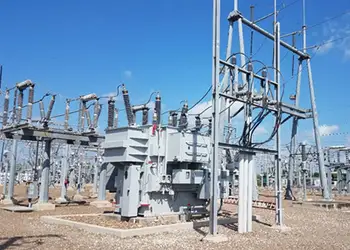
Substation Relay Protection Training
Our customized live online or in‑person group training can be delivered to your staff at your location.
- Live Online
- 12 hours Instructor-led
- Group Training Available
Regular Price:
$699
Coupon Price:
$599
Zero carbon homes levy, funding local renewable energy, tariffs, and buy-out funds, enables offsite wind, solar, geothermal, and district heating to offset residential CO2, meeting Code for Sustainable Homes and UK zero-carbon targets.
What This Means
A developer tariff funding local renewables to offset new homes' CO2 via wind, solar, geothermal, and district heating.
- Tariff of about £15,000 per non-level 6 home
- Funds local wind, solar, geothermal, district heating plants
- Offsets residential CO2 where on-site renewables are impractical
- Managed via buy-out funds and local energy infrastructure
- Supports UK Code for Sustainable Homes and 2016 targets
Every new home is to be powered by a green energy plant to offset its environmental impact under government plans for zero-carbon living from 2016.
If a development is too small, remote or shielded from wind or sun for an effective renewables scheme, developers will pay a levy to the local council, in line with UK net zero policies aimed at cutting emissions, to create bigger plants nearby that would cancel out the carbon footprint of the homes, while providing green power. According to government figures, more than a quarter of all CO2 emissions come from residential properties.
All new homes are rated under the Code for Sustainable Homes. Where planned properties do not reach the highest level 6 standard – where their own green energy production offsets their emissions – developers would be charged a tariff of around £15,000 by the local council to fund infrastructure and local services, despite concerns that UK energy prices could rise, in the longer term. Part of this would also include contributing to a "buy-out fund" to pay for the construction of wind farms, solar panels or geothermal technologies in the local area, which would supply the new development with green power.
It is hoped the plan would result in economies of scale, even as emission cuts risk remains in a recovering economy, where a larger renewable energy plant could offset the carbon emissions of several small plots of houses.
The housing minister, Grant Shapps, said: "We are committed to being the greenest government ever, and an essential part of that is to ensure that all homes in the future will be built without emitting any carbon. This announcement is an important and very significant step in that direction because for the first time we have described in detail how developers might be expected to achieve zero carbon, backed by green growth funding across the country, by connecting developments to local energy schemes."
Labour set the 2016 zero-carbon target in 2006 but did little to explain how it would be met, or even what the definition meant. The coalition has given £600,000 to the public-private body Zero Carbon Hub to begin testing new benchmarks for carbon emission reductions, amid debate over the EU green plan and its implications, for the sector. However, even supporters of the scheme complain that the coalition has reneged on a promise to set out a definition for a zero-carbon home "within weeks" of taking office.
Simon McWhirter, from the conservation charity WWF, said the levy on developers was "really important" to ensure that new properties, such as flats, which cannot practically generate enough green power on site, can still be zero carbon, aligning with shifts toward electric cars across the wider economy. "The ability for small builders to pay into a pot which will then be used independently to deliver the emissions reductions elsewhere is a sensible approach to take."
Ministers are also being urged to ensure that building guidelines do not include measures to prevent loss of heat and power that make the homes uninhabitable, through overheating or poor ventilation.
Dr David Strong, chief executive of consultancy Inbuilt and a member of the Zero Carbon Hub's task group, said: "My big worry is as we start to build our homes to increasing standards, unless there is considerable care in the way they are designed and built, there is a real danger of a whole lot of perverse outcomes."
Nottingham City Council already runs a district heating system, alongside emerging North Sea carbon capture initiatives, in which domestic and commercial waste is used to provide electricity and hot water to more than 4,600 homes, the National Ice Centre, and two shopping centres.
Related News
Related News

How to Get Solar Power on a Rainy Day? Beam It From Space
Space solar power promises wireless energy from orbital solar satellites via microwave or laser power…
View more

Is 5G a waste of electricity? Experts say it's complicated
5G Energy Costs highlight base station power consumption, carrier electricity bills, and carbon emissions in…
View more
Biden's Announcement of a 100% Tariff on Chinese-Made Electric Vehicles
U.S. 100% Tariff on Chinese EVs aims to protect domestic manufacturing, counter subsidies, and reshape…
View more

Are we ready for electric tractors?
Electric tractors are surging, with battery-powered models, grid-tethered JD GridCON, and solar-charged designs delivering autonomous…
View more
Nova Scotia Eyes Offshore Wind for U.S. Power Markets
Nova Scotia is advancing offshore wind plans to meet rising electricity demand at home while…
View more
Mexican president's contentious electricity overhaul defeated in Congress
Mexico Energy Reform Defeat underscores opposition unity as CFE-first rules, state regulators, and lithium nationalization…
View more
Sign Up for Electricity Forum’s Newsletter
Stay informed with our FREE Newsletter — get the latest news, breakthrough technologies, and expert insights, delivered straight to your inbox.
Electricity Today T&D Magazine Subscribe for FREE

Stay informed with the latest T&D policies and technologies.
- Timely insights from industry experts
- Practical solutions T&D engineers
- Free access to every issue

