Thomas Edison Electricity
By R.W. Hurst, Editor
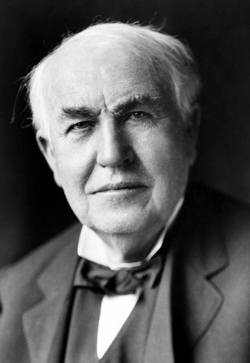
Thomas Edison helped transform electricity from a scientific curiosity into a practical public utility. His work on electric lighting, direct current distribution systems, and centralized power generation made large-scale electric service possible.
Thomas Edison did not discover electricity, but he helped turn it into a practical utility service. His most important contribution was not electric power itself but the development of commercially viable electric lighting, direct current distribution systems, and centralized power generation for urban use.
Thomas Edison helped transform electricity from a scientific curiosity into a practical public utility. His work on electric lighting, direct current distribution systems, and centralized power generation made large-scale electric service possible.
Thomas Edison did not discover electricity, but he helped turn it into a practical utility service. His most important contribution was not electric power itself but the development of commercially viable electric lighting, direct current distribution systems, and centralized power generation for urban use. The practical systems developed by Edison and his engineering teams helped establish the first working electric utility networks in major cities.
Edison’s electrical work focused on making power usable at scale. His lighting systems, meters, generators, and distribution equipment allowed electric power to move from laboratory demonstrations into homes, streets, and businesses.
That shift mattered because practical electric service required more than a light bulb. It required generation, wiring, protection, metering, and system design that could operate reliably in a dense urban environment.
Did Thomas Edison Invent Electricity?
Thomas Edison did not invent electricity; instead, he developed practical systems that enabled its generation, distribution, and commercial use.
Thomas Edison Electricity Systems and Early Electric Utilities
Thomas Edison’s importance in electricity came from system building. Many scientists had already studied electrical forces, current flow, and electromagnetic effects before Edison’s major work began. What Edison added was a practical method for delivering electric light and power in a form that customers, cities, and businesses could actually use. The broader scientific and technical background behind those earlier discoveries is explained in History of Electricity.
His electrical work was grounded in a simple commercial reality. A useful lamp meant very little without a generator to produce power, conductors to distribute it, switches to control it, and meters to measure consumption. Edison understood that electric service had to function as an integrated system rather than a single invention. That judgment separated laboratory success from public adoption.
His early background as a telegraph operator mattered because it exposed him to circuits, signal transmission, switching, and the discipline of reliable electrical operation. Telegraphy trained him to think in terms of working networks, not isolated devices. That perspective later influenced how he approached electric lighting and power distribution.

Pearl Street Station and the First Electric Utility
In 1882, Edison opened the Pearl Street Station power plant in New York City. This station generated 110-volt direct current electricity and supplied power to customers in lower Manhattan, becoming one of the first commercial electric utility systems in the world. The project demonstrated that centralized generation and distribution of electricity could operate reliably in a dense urban environment.
The Practical Incandescent Lamp
Edison is most closely associated with the practical incandescent lamp. He did not invent the idea of electric lighting from nothing, but he helped produce a version that lasted long enough, operated consistently enough, and fit into a complete electrical supply system. That difference is important. The engineering problem was not merely to create light. The real problem was to create a lamp that could survive real operating conditions and support broad commercial use.
Edison helped produce a version that lasted long enough, operated consistently enough, and used filament materials capable of maintaining electrical resistance under continuous operation.
A practical lighting system also required voltage control, conductor sizing, distribution layout, and load management. If any one of those elements failed, the lamp itself would not matter. Edison’s achievement was therefore not a single bulb in isolation, but a workable lighting platform tied to a larger electrical network. Understanding how line conditions affect reliable operation begins with fundamentals such as Voltage, which shaped early lamp and distribution design.
Edison’s system also required reliable electrical energy meters so utilities could accurately measure energy consumption and bill customers, making commercial electric service financially sustainable.
Centralized Generation and Distribution
Edison’s most important electrical contribution was the centralized generation and distribution of electric power for urban service. His direct current systems were designed to generate electric power in one location and distribute it outward to nearby customers. This model helped establish the idea of electric service as a managed utility rather than a collection of private experiments. His approach to local supply and load service is closely related to the principles described in Electricity Generation.
That was a major turning point in electrical history. Once electric power could be generated centrally and sold reliably to multiple customers, it became part of the daily infrastructure. Homes, offices, and streets could be illuminated without relying on candles, oil lamps, or localized mechanical systems. The consequence was not just better lighting. It was a new model for urban activity, safety, labor, and commerce.


| Year | Invention/Contribution | Significance |
|---|---|---|
| 1877 | Phonograph | First device to record sound |
| 1879 | Incandescent Light Bulb | Practical, long-lasting lighting |
| 1882 | Power Distribution Grid | First commercial electric power station |
| 1887 | Menlo Park Lab | First R&D facility |
| 1892 | General Electric | Major utility and tech firm |
Why Edison’s DC System Mattered
Edison’s direct current system worked well for dense local service, particularly in areas where customers were relatively close to the generating source. For early city lighting, that mattered. A practical DC system proved that Thomas Edison electricity could move beyond demonstration and become an operating public service. The operating characteristics of Edison’s early networks are better understood through the fundamentals of Direct Current.
But the system also had a serious limitation. Direct current was difficult to transmit efficiently over long distances at the scale required to meet expanding electrical demand. That tradeoff became more important as electrification moved beyond compact urban blocks. Edison’s system was practical, but it was not the most scalable architecture for the larger power networks that would follow.
That limitation is one reason Edison’s legacy has to be understood with precision. He helped establish commercial electrical service, but later, grid expansion required different transmission solutions.
Edison, Tesla, and the Shift to AC
As demand for electrical service expanded, alternating current systems gained an advantage because voltage could be transformed more easily for long-distance transmission and then reduced for end use. This made AC better suited to broader regional power networks. The technical distinction between Edison’s system and later transmission models is explained further in What Is Alternating Current.
That does not reduce Edison’s significance. It clarifies it. Edison was essential in proving that electric lighting and utility service could operate as both a business and an engineered system. Tesla and others helped solve the transmission problem at larger scale. Edison’s role was foundational, but it belonged primarily to the first practical stage of commercial electrification.
Research, Development, and Industrial Innovation
Edison also influenced electricity through organization. His laboratory model brought investigation, testing, iteration, and product development into a more systematic industrial process. That mattered because practical electrical systems required repeated refinement, not just inspiration. Materials, lamp performance, system reliability, and component integration all demanded continuous testing.
This research model helped accelerate electrical innovation beyond that of a single inventor. It connected experimentation to deployment, which is one reason Edison remained influential even when particular technologies changed.
Thomas Edison’s Electrical Legacy
Thomas Edison’s electrical legacy rests on practical system design. He helped make electric lighting commercially viable, built direct current distribution systems, and advanced centralized generation for urban use. He did not invent electrical power, but he played a major role in turning it into a working public utility. His place in the broader story of discovery and application is also connected to the larger question explored in Who Invented Electricity.
That distinction is the key to understanding Edison correctly. His importance lies less in discovery than in application. He helped move Thomas Edison electricity from a scientific possibility to an operational infrastructure. Without that transition, electric power would have remained a laboratory phenomenon for far longer.
The systems Edison pioneered established the basic model for electric utilities: centralized generation, controlled distribution networks, and metered customer consumption.
Related Articles

