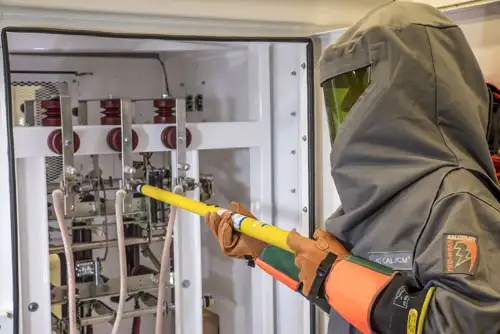
High Voltage Maintenance Training Online
Our customized live online or in‑person group training can be delivered to your staff at your location.
- Live Online
- 12 hours Instructor-led
- Group Training Available
Regular Price:
$599
Coupon Price:
$499
Energy Minister Dwight Duncan is saying that Ontario will probably have to build more nuclear generating stations.
He sees a need for them not because the province is going to shut down all coal-fired generating stations by 2009. As is plain from recent announcements and from the website of the Independent Electricity System Operator at http://www.theimo.com, there will be enough new projects to replace the coal-fired stations.
No, the reason for Duncan's concern is that existing nuclear reactors will reach the end of their life expectancy in 2020. If their 11,834 megawatt generating capacity is to be replaced with new nuclear plants, the decision must be made immediately, because construction takes 12 to 15 years.
It's easy to see Duncan's dilemma. Building nuclear plants looks like a sure bet for securing supplies of electricity. But it will come at a tremendous cost, and a lot of opposition from people wary of the danger associated with nuclear plants, who are leery of the pollution created by nuclear waste, or who are concerned about the long history of glitches and questionable reliability at Ontario's plants.
The standard CANDU nuclear station, with eight units and a generating capacity of 5,600 megawatts, sells for $16 billion. Atomic Energy of Canada Ltd. says it is designing an advanced CANDU with the same capacity that will sell for $12 billion. But even if the advanced reactors can be designed in time, Ontario's experience suggests there will be large cost overruns, and long construction delays.
So building nuclear plants is not such a sure bet.
However, there are alternatives. Let me mention just one partial option: domestic furnaces to heat and cool homes, and, at the same time, generate electricity. Versions of such furnaces are used in Europe and Japan, and information about them can be found on the Internet under "micro co-gen," and "micro chp" (for central heat and power).
Micro co-generation furnaces would cost roughly $10,000 to $14,000. If they were installed in only half of Ontario's 2.5 million detached, single-family homes over the next 15 years, they would generate about 3,750 megawatts of electricity (assuming each generated an average of 3 kilowatts), mainly during hours of peak demand. Add to that 1,350 megawatts that Ontario's Clean Air Alliance estimates could be saved immediately through conservation, plus another 338 megawatts in reduced transmission losses, because less electricity would be piped into each home from the provincial grid and — voila! — the need for an entire, eight-unit nuclear station would be eliminated.
The cost of installing the furnaces would be comparable to the price quoted for a nuclear plant. But homeowners could recover their outlay within seven years, if the province gave them credit for the electricity they produced at the going rate paid to other producers (which is higher than the subsidized price consumers pay). Financial incentives would make the recovery time even more attractive.
This is not new and risky technology, but it does demand that the province move to a decentralized system of electricity production. And that's a battle it has yet to win over the bureaucratic establishment.
Related News
France and Germany arm wrestle over EU electricity reform
EU Electricity Market Reform CFDs seek stable prices via contracts for difference, balancing renewables and…
View more
Medicine Hat Grant Winners to Upgrade Grid and Use AI for Energy Savings
Medicine Hat Smart Grid AI modernizes electricity distribution with automation, sensors, and demand response, enhancing…
View more
From smart meters to big batteries, co-ops emerge as clean grid laboratories
Minnesota Electric Cooperatives are driving grid innovation with smart meters, time-of-use pricing, demand response, and…
View more
Climate change: Greenhouse gas concentrations again break records
Rising Greenhouse Gas Concentrations drive climate change, with CO2, methane, and nitrous oxide surging; WMO…
View more
America Going Electric: Dollars And Sense
California Net Zero Grid Investment will fuel electrification, renewable energy buildout, EV adoption, and grid…
View more
Sask. sets new record for power demand
SaskPower Summer Power Demand Record hits 3,520 MW as heat waves drive electricity consumption; grid…
View more
Sign Up for Electricity Forum’s Newsletter
Stay informed with our FREE Newsletter — get the latest news, breakthrough technologies, and expert insights, delivered straight to your inbox.
Electricity Today T&D Magazine Subscribe for FREE

Stay informed with the latest T&D policies and technologies.
- Timely insights from industry experts
- Practical solutions T&D engineers
- Free access to every issue
