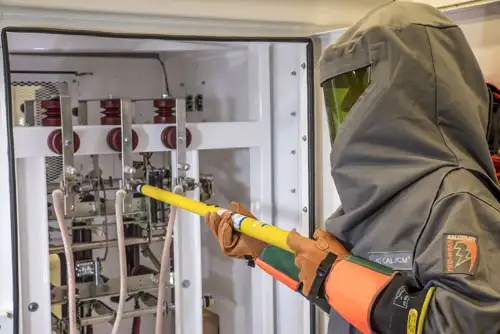
High Voltage Maintenance Training Online
Our customized live online or in‑person group training can be delivered to your staff at your location.
- Live Online
- 12 hours Instructor-led
- Group Training Available
Regular Price:
$599
Coupon Price:
$499
The Tennessee Valley Authority is in the midst of a $6 billion program to curb air pollution, but half a dozen of its coal plants appeared on a list of America's dirtiest power plants.
Among the nation's 359 power plants, TVA had six plants that were among the 50 dirtiest for different pollutants measured during 2004 by the Environmental Protection Agency.
TVA's worst plants for sulfur dioxide pollution linked with acid rain included the Johnsonville and Kingston plants in Tennessee. Both the plants produced more than twice as much sulfur pollutants per unit of electricity generated than the average among all U.S. coal plants, according to the study.
Nationwide, the Environmental Integrity Project blamed the nation's 50 dirtiest coal plants for generating nearly half the soot and smog while generating only 14 percent of the electricity of all plants.
"A disproportionate share of emissions comes from a handful of plants that have not yet installed modern pollution controls, or which operate inefficiently," said Ilan Levin, counsel for the Washington, D.C.-based environmental group that produced the report on "Dirty Kilowatts."
TVA officials and other industry leaders insist such controls continue to be installed at more coal plants every day.
"We're spending more than $1 million a day on the most aggressive control program in the country," said John Shipp, vice president of environmental policy at TVA. "We're doing it about as fast as we can and as quickly as the ratepayers can reasonably pay."
The Environmental Integrity Project, which used EPA data collected from utilities' "right to know" filings, showed most of the dirtiest coal plants last year were in the Midwest. The report showed Ohio and Pennsylvania each had nine of the 50 dirtiest coal plants, Indiana had six and Georgia had four. Alabama and Maryland each had three of the dirtiest plants, while New York and Tennessee each had two.
Last year, TVA's sulfur-dioxide emissions fell to 493,000 tons, or 78 percent less than the peak level in 1977. Nitrogen oxide emissions during 2004 from TVA plants were down by 78 percent from the peak in 1977, records show.
Mr. Shipp said emissions from Johnsonville will be cut significantly in coming years with the conversion of the plant to low-sulfur coal, and pollution from Kingston in Tennessee and Paradise in Kentucky also will drop with the additions of coal scrubbers on more units at those plants.
The Bush administration also is expected to publish today its Clean Air Interstate Rules (CAIR) that will mandate further reductions by 2010 at most of the plants identified in the list of dirty plants.
"The Environmental Integrity Project is throwing the same old punches, but frankly they're a little behind the times," said Dan Riedinger, a spokesman for Edison Electric Institute, a trade group for U.S. utilities. "One might think that the more the power sector reduces emissions, the less our critics would be inclined to complain. That's clearly not always the case."
Eric Schaeffer, a former EPA official who founded the Environmental Integrity Project to encourage stricter pollution controls, said the successes at some power plants highlight the lingering problems at others.
"The real tragedy for the health of Americans and our environment is that most of this problem is already preventable," he said.
Mr. Schaeffer said the Office of Management and Budget has estimated that the health costs incurred for each ton of sulfur dioxide average about $7,300.
"When you consider the health costs, scrubbers are actually pretty cheap," he said.
Mr. Shipp said studies indicate scrubbers can be installed at most coal plants at a cost of about $300 per ton of sulfur dioxide emitted.
TVA expects to have spent $6 billion for pollution controls by 2010 at its 11 coal-fired plants, and new CAIR and Clear Skies regulations could cost TVA billions of dollars more.
Mr. Shipp noted that TVA has one of the most efficient coal plants in the world at Bull Run near Oak Ridge and it soon will have both scrubbers and selective catalytic reduction devices to limit nitrogen oxides at the biggest units at its Cumberland, Paradise and Widows Creek plants.
"This study only talks about the worst plants, but it doesn't say anything about our successful plants," Mr. Shipp said.
Related News

Electric cars will challenge state power grids
Electric Vehicle Grid Integration aligns EV charging with grid capacity using smart charging, time-of-use rates,…
View more

Californians Learning That Solar Panels Don't Work in Blackouts
Rooftop Solar Battery Backup helps Californians keep lights on during PG&E blackouts, combining home energy…
View more

Ameren, Safe Electricity urge safety near downed lines
Downed Power Line Vehicle Safety: Follow stay-in-the-car protocol, call 911, avoid live wires and utility…
View more
Can California Manage its Solar Boom?
California Duck Curve highlights midday solar oversupply and steep evening peak demand, stressing grid stability.…
View more

COVID-19 crisis shows need to keep electricity options open, says Birol
Electricity Security and Firm Capacity underpin reliable supply, balancing variable renewables with grid flexibility via…
View more
Clean B.C. is quietly using coal and gas power from out of province
BC Hydro Electricity Imports shape CleanBC claims as Powerex trades cross-border electricity, blending hydro with…
View more
Sign Up for Electricity Forum’s Newsletter
Stay informed with our FREE Newsletter — get the latest news, breakthrough technologies, and expert insights, delivered straight to your inbox.
Electricity Today T&D Magazine Subscribe for FREE

Stay informed with the latest T&D policies and technologies.
- Timely insights from industry experts
- Practical solutions T&D engineers
- Free access to every issue

