Protective Relay Training - Basic
Our customized live online or in‑person group training can be delivered to your staff at your location.
- Live Online
- 12 hours Instructor-led
- Group Training Available
Regular Price:
$699
Coupon Price:
$599
Ontario householders should have to pay a higher price if they use electricity during peak demand periods when the electricity system is under stress, says the Ontario Energy Board.
How much higher? The board doesn't say — but does note that a pilot conservation program in Wisconsin charges 12 times more for power used during peak periods than in off-peak times.
Electricity use is highest during the summer and winter, and generally peaks about 4 to 9 p.m. as people come home from work and turn on appliances.
The energy board also says electricity consumers should pay an extra charge on their bill to fund conservation programs.
Its recommendations are contained in a report to Energy Minister Dwight Duncan, who is expected to introduce legislation this spring to start reshaping Ontario's electricity system.
The board says a central electricity conservation agency, supervised by the energy board, should be created. Some programs would be aimed at reducing over-all demand; others would be targeted at cutting demand at key times when demand threatens to outstrip supply.
Power use in Ontario has been climbing steadily, and the province has come close to running out of power several times, apart from the major blackout Aug. 14 that hit Ontario and much of the northeastern United States.
Meanwhile, the new Liberal government is also committed to shutting down Ontario's coal-burning generating stations by 2007, and has been warned that the province's nuclear stations — which supply more than 40 per cent of the province's power — will reach the end of their lives by 2020.
The electricity conservation agency — funded through a charge on electricity — would draw up a conservation plan for the province, then approve and fund local hydro utilities or other market players who want to run conservation programs. It would also evaluate the results.
Some local utilities had argued that they should design and run their own individual programs, but the energy board says a single agency would allow greater economies of scale and provide consistent policies across the province — an important issue for businesses with many operations.
While the province runs short of power, householders have been paying below-market prices for nearly two years. In January this year, the province set an all-time monthly record for power consumption.
That should stop, the energy board says. Customers who don't sign fixed-price contracts with energy retailers should pay more to use power when the system is strained, which generally occurs during very hot and very cold weather.
"In the summer and winter, the difference between peak and off-peak prices should be large enough to cause shifting in consumption," the board says.
The problem with charging higher prices from, say, 4 to 11 p.m., is that few households in the province have meters that record what time of day a kilowatt hour was used. Ordinary meters just tell the utility the total amount of power used between readings.
Sophisticated meters are on the market that can do the job, but they're expensive, and the board's report says it hasn't seen any evidence to justify installing new meters in every household.
Donna Garant, a spokesperson for the board, says one approach is to track over-all time-of-day consumption in the province, and assume all consumers follow the same pattern.
The drawback to that approach is that some consumers will do the right thing and run their dryers at 2 a.m., but they won't be rewarded any more than people who fire up their dryers at 6 p.m. when the system is strained to the limit.
Local utilities have complained that they'll be punished for encouraging conservation because their revenues will drop if customers use less power. The board says it will devise an appropriate solution.
Related News
Green energy could drive Covid-19 recovery with $100tn boost
Renewable Energy Economic Recovery drives GDP gains, job growth, and climate targets by accelerating clean…
View more
Ontario Power Generation's Commitment to Small Modular Reactors
OPG Small Modular Reactors advance clean energy with advanced nuclear, baseload power, renewables integration, and…
View more
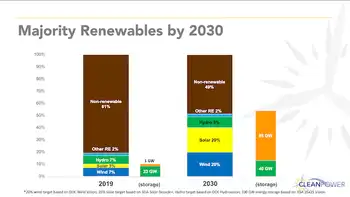
U.S. Renewable and Clean Energy Industries Set Sights on Market Majority
U.S. Majority Renewables by 2030 targets over half of electricity from wind, solar, hydropower, and…
View more

Gulf Power to Provide One-Time Bill Decrease of 40%
Gulf Power 40% One-Time Bill Decrease approved by the Florida Public Service Commission delivers a…
View more
Hydro-Quebec won't ask for rate hike next year
Hydro-Quebec Rate Freeze maintains current electricity rates, aligned with Bill 34, inflation indexing, and energy…
View more

California electricity pricing changes pose an existential threat to residential rooftop solar
California Rooftop Solar Rate Reforms propose shifting net metering to fixed access fees, peak-demand charges,…
View more
Sign Up for Electricity Forum’s Newsletter
Stay informed with our FREE Newsletter — get the latest news, breakthrough technologies, and expert insights, delivered straight to your inbox.
Electricity Today T&D Magazine Subscribe for FREE

Stay informed with the latest T&D policies and technologies.
- Timely insights from industry experts
- Practical solutions T&D engineers
- Free access to every issue

