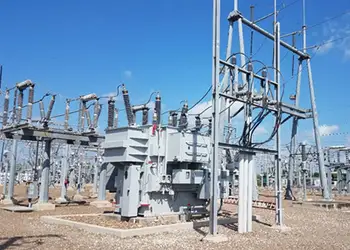
Substation Protection Training - Protect Transformers, Buses and Lines
Our customized live online or in‑person group training can be delivered to your staff at your location.
- Live Online
- 12 hours Instructor-led
- Group Training Available
Regular Price:
$799
Coupon Price:
$699
Researchers have developed a technique that uses sensors and computational software to constantly monitor forces exerted on wind turbine blades, a step toward improving efficiency by adjusting for rapidly changing wind conditions.
The research by engineers at Purdue University and Sandia National Laboratories is part of an effort to develop a smarter wind turbine structure.
"The ultimate goal is to feed information from sensors into an active control system that precisely adjusts components to optimize efficiency," said Purdue doctoral student Jonathan White, who is leading the research with Douglas Adams, a professor of mechanical engineering and director of Purdue's Center for Systems Integrity.
The system also could help improve wind turbine reliability by providing critical real-time information to the control system to prevent catastrophic wind turbine damage from high winds.
"Wind energy is playing an increasing role in providing electrical power," Adams said. "The United States is now the largest harvester of wind energy in the world. The question is, what can be done to wind turbines to make them more efficient, more cost effective and more reliable?"
The engineers embedded sensors called uniaxial and triaxial accelerometers inside a wind turbine blade as the blade was being built. The blade is now being tested on a research wind turbine at the U.S. Department of Agriculture's Agriculture Research Service laboratory in Bushland, Texas. Personnel from Sandia and the USDA operate the research wind turbines at the Texas site.
Such sensors could be instrumental in future turbine blades that have "control surfaces" and simple flaps like those on an airplane's wings to change the aerodynamic characteristics of the blades for better control. Because these flaps would be changed in real time to respond to changing winds, constant sensor data would be critical.
Research findings show that using a trio of sensors and "estimator model" software developed by White accurately reveals how much force is being exerted on the blades. Purdue and Sandia have applied for a provisional patent on the technique.
"The aim is to operate the generator and the turbine in the most efficient way, but this is difficult because wind speeds fluctuate," Adams said. "You want to be able to control the generator or the pitch of the blades to optimize energy capture by reducing forces on the components in the wind turbine during excessively high winds and increase the loads during low winds. In addition to improving efficiency, this should help improve reliability. The wind turbine towers can be 200 feet tall or more, so it is very expensive to service and repair damaged components."
Sensor data in a smart system might be used to better control the turbine speed by automatically adjusting the blade pitch while also commanding the generator to take corrective steps.
"We envision smart systems being a potentially huge step forward for turbines," said Sandia's Rumsey. "There is still a lot of work to be done, but we believe the payoff will be great. Our goal is to provide the electric utility industry with a reliable and efficient product. We are laying the groundwork for the wind turbine of the future."
Sensor data also will be used to design more resilient blades.
The sensors are capable of measuring acceleration occurring in various directions, which is necessary to accurately characterize the blade's bending and twisting and small vibrations near the tip that eventually cause fatigue and possible failure.
The sensors also measure two types of acceleration. One type, the dynamic acceleration, results from gusting winds, while the other, called static acceleration, results from gravity and the steady background winds. It is essential to accurately measure both forms of acceleration to estimate forces exerted on the blades. The sensor data reveal precisely how much a blade bends and twists from winds.
Related News
UK families living close to nuclear power stations could get free electricity
UK Nuclear Free Electricity Incentive proposes community benefits near reactors, echoing France, supporting net zero…
View more
Electricity prices in Germany nearly doubled in a year
Germany Energy Price Hikes are driving electricity tariffs, gas prices, and heating costs higher as…
View more
China boosts wind energy, photovoltaic and concentrated solar power
China Renewable Energy Law drives growth in wind power, solar thermal, and photovoltaic capacity, supporting…
View more

South Australia rides renewables boom to become electricity exporter
Australia electricity grid transition is accelerating as renewables, wind, solar, and storage drive decentralised generation,…
View more
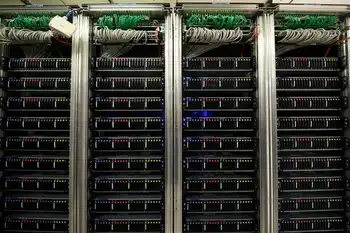
China's Data Centers Alone Will Soon Use More Electricity Than All Of Australia
Cloud Data Centers Environmental Impact highlights massive electricity use, carbon emissions, and cooling demands, with…
View more

Lawmakers question FERC licensing process for dams in West Virginia
FERC Hydropower Licensing Dispute centers on FERC authority, Clean Water Act compliance, state water quality…
View more
Sign Up for Electricity Forum’s Newsletter
Stay informed with our FREE Newsletter — get the latest news, breakthrough technologies, and expert insights, delivered straight to your inbox.
Electricity Today T&D Magazine Subscribe for FREE

Stay informed with the latest T&D policies and technologies.
- Timely insights from industry experts
- Practical solutions T&D engineers
- Free access to every issue