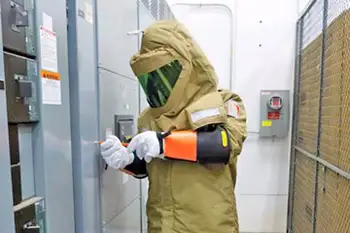
CSA Z462 Arc Flash Training – Electrical Safety Compliance Course
Our customized live online or in‑person group training can be delivered to your staff at your location.
- Live Online
- 6 hours Instructor-led
- Group Training Available
Regular Price:
$249
Coupon Price:
$199
A radiation monitoring device spotted in Iran at a razed site where Washington suspects Iran conducted covert atomic bomb-related research was itself made in the United States and sold directly to Tehran, sources said.
A Western diplomat and an independent nuclear expert who follow the Vienna-based U.N. International Atomic Energy Agency (IAEA) told Reuters the radiation detection device -- called a ``whole body counter'' -- was identified as having been made by the Connecticut-based firm Canberra Industries, Inc. The disclosure could prove embarrassing to Washington which has accused Iran of pursuing a nuclear weapons program and has called on countries to crack down on exports of even seemingly innocent machinery that could be used in weapons programs. Tehran says it only wants nuclear power for electricity. ``There is no doubt that the whole-body counter came from Canberra Industries and under a legal export,'' said the nuclear science expert, who has analyzed satellite images of the site taken by the U.S. firm DigitalGlobe's Quickbird satellite. The counter, used to measure radiation contamination in humans, was sold directly to a university or hospital in Iran in the early 1990s with a U.S. export license, the sources said. The device was seen at Lavizan, situated near a military installation in Tehran. Satellite images of Lavizan show Tehran razed buildings and removed a significant amount of topsoil. Ironically, the U.S.-made device is the reason U.S. officials are convinced Iran pursued undeclared atomic activity there. ``The presence of the whole body counter there is weird and out of place, but it doesn't prove that there was any weapons activity going on at Lavizan,'' said David Albright, president of the Institute for Science and International Securityand a former U.N. weapons inspector. ``We need to know how it got there (from the hospital or university) and why,'' he added. Lavizan was first mentioned in May 2003, when a group of Iranian exiles said it was a biological weapons research site. Iran vehemently denied that it has conducted any undeclared nuclear or weapons-related activities at Lavizan. But a diplomat close to the IAEA said inspectors would go there ``very soon.'' NEW DEMOLITION WORK AT SUSPECT SITE Canberra Industries declined to comment, but an industry source familiar with devices like whole-body counter said it was a ``totally innocuous'' device designed for peaceful activity. Asked if the counter could be modified to detect plutonium or other substances to make it usable in weapons-related activity, the source, who declined to be identified, said: ``Very theoretically speaking, all kinds of things can be done,'' the source said. Last week, Reuters obtained from ISIS and GlobalDigital two satellite photos taken in August 2003 and March 2004 that showed Iran had dismantled buildings and removed rubble and topsoil at the site, called the Lavizan-Shiyan Technical Research Center. The U.S. ambassador to the IAEA, Kenneth Brill, accused Iran of using ``the wrecking ball and bulldozer'' to sanitize Lavizan prior to the arrival of U.N. inspectors. ``This destruction at the site raised concerns because it is the type of measure Iran would need to take if it was trying to defeat the powerful environmental sampling capabilities of IAEA inspectors,'' ISIS said in an analysis of the images. Last week the IAEA Board of Governors unanimously passed a resolution that sharply rebuked Iran for not cooperating fully with a U.N. investigation of Tehran's nuclear program. The IAEA began investigating Iran after an Iranian exile group reported in August 2002 that Tehran was hiding a massive uranium enrichment facility and other sites from the IAEA.
The disclosure could prove embarrassing to Washington which has accused Iran of pursuing a nuclear weapons program and has called on countries to crack down on exports of even seemingly innocent machinery that could be used in weapons programs.
Tehran says it only wants nuclear power for electricity.
``There is no doubt that the whole-body counter came from Canberra Industries and under a legal export,'' said the nuclear science expert, who has analyzed satellite images of the site taken by the U.S. firm DigitalGlobe's Quickbird satellite.
The counter, used to measure radiation contamination in humans, was sold directly to a university or hospital in Iran in the early 1990s with a U.S. export license, the sources said.
The device was seen at Lavizan, situated near a military installation in Tehran. Satellite images of Lavizan show Tehran razed buildings and removed a significant amount of topsoil. Ironically, the U.S.-made device is the reason U.S. officials are convinced Iran pursued undeclared atomic activity there.
``The presence of the whole body counter there is weird and out of place, but it doesn't prove that there was any weapons activity going on at Lavizan,'' said David Albright, president of the Institute for Science and International Securityand a former U.N. weapons inspector.
``We need to know how it got there (from the hospital or university) and why,'' he added.
Lavizan was first mentioned in May 2003, when a group of Iranian exiles said it was a biological weapons research site.
Iran vehemently denied that it has conducted any undeclared nuclear or weapons-related activities at Lavizan. But a diplomat close to the IAEA said inspectors would go there ``very soon.''
NEW DEMOLITION WORK AT SUSPECT SITE
Canberra Industries declined to comment, but an industry source familiar with devices like whole-body counter said it was a ``totally innocuous'' device designed for peaceful activity.
Asked if the counter could be modified to detect plutonium or other substances to make it usable in weapons-related activity, the source, who declined to be identified, said:
``Very theoretically speaking, all kinds of things can be done,'' the source said.
Last week, Reuters obtained from ISIS and GlobalDigital two satellite photos taken in August 2003 and March 2004 that showed Iran had dismantled buildings and removed rubble and topsoil at the site, called the Lavizan-Shiyan Technical Research Center.
The U.S. ambassador to the IAEA, Kenneth Brill, accused Iran of using ``the wrecking ball and bulldozer'' to sanitize Lavizan prior to the arrival of U.N. inspectors.
``This destruction at the site raised concerns because it is the type of measure Iran would need to take if it was trying to defeat the powerful environmental sampling capabilities of IAEA inspectors,'' ISIS said in an analysis of the images.
Last week the IAEA Board of Governors unanimously passed a resolution that sharply rebuked Iran for not cooperating fully with a U.N. investigation of Tehran's nuclear program.
The IAEA began investigating Iran after an Iranian exile group reported in August 2002 that Tehran was hiding a massive uranium enrichment facility and other sites from the IAEA.
Related News
Severe heat: 5 electricity blackout risks facing the entire U.S., not just Texas
Texas power grid highlights ERCOT reliability strains from extreme heat, climate change, and low wind,…
View more

Ukraine Boosts Electricity Imports From Europe as Grid Faces War Strain
Ukraine has increased electricity imports from Europe to stabilize its energy system after Russian strikes…
View more

Electricity users in Newfoundland have started paying for Muskrat Falls
Muskrat Falls rate mitigation offsets Newfoundland Power's rate stabilization decrease as NL Hydro begins cost…
View more

Is a Resurgence of Nuclear Energy Possible in Germany?
Germany Nuclear Phase-Out reflects a decisive energy policy shift, retiring reactors as firms shun new…
View more
U.S. Grid overseer issues warning on Coronavirus
NERC COVID-19 Grid Security Alert urges utilities to update business continuity plans, assess supply chain…
View more

Growing pot sucks up electricity and pumps out an astounding amount of carbon dioxide — it doesn't have to
Sustainable Cannabis Cultivation leverages greenhouse design, renewable energy, automation, and water recapture to cut electricity…
View more
Sign Up for Electricity Forum’s Newsletter
Stay informed with our FREE Newsletter — get the latest news, breakthrough technologies, and expert insights, delivered straight to your inbox.
Electricity Today T&D Magazine Subscribe for FREE

Stay informed with the latest T&D policies and technologies.
- Timely insights from industry experts
- Practical solutions T&D engineers
- Free access to every issue
