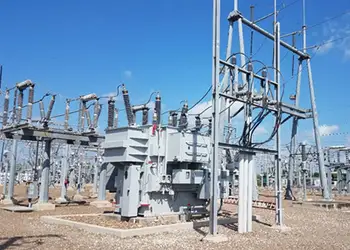
Substation Relay Protection Training
Our customized live online or in‑person group training can be delivered to your staff at your location.
- Live Online
- 12 hours Instructor-led
- Group Training Available
Regular Price:
$699
Coupon Price:
$599
With a lump of coal in one hand and the prairie wind in the other, Kansas is marching into its energy future.
The state is poised to approve one of the largest coal-fired power plants ever built west of the Mississippi River, even as officials announced plans recently for transmission lines designed to encourage more wind farms. To utility companies and key officials, this is the right direction. They say that the state must embrace an energy mix of coal and wind and that pitting the two sources against each other is wrongheaded.
"Adding wind generation to the Kansas electrical generation portfolio is part of the solution - but we cannot expect it to be the solution," Gov. Kathleen Sebelius said in a news release.
But environmental groups want a greater focus on wind and conservation. They argue that another big coal plant - and its carbon emissions - is the wrong direction as concerns about global climate change increase. Tom Thompson of the Kansas Sierra Club said that with all the talk about wind energy and conservation, a new coal plant is "a self-defeating proposition."
"Kansas has the third-greatest potential for wind in the country," Thompson said. "We should be able to do better." While the debate plays out, developments show that Kansas' energy future is starting now:
- Recently, transmission-line regulators announced plans to create new lines that will knit eastern and western Kansas and allow much greater production and transmission of wind energy.
Already, utility companies have announced plans to surpass Sebelius goal of generating 10 percent of the state's energy through wind by 2010.
- State environmental regulators are expected to announce soon whether to permit Sunflower Electric to build two 700-megawatt coal-fired power generators near Holcomb in southwest Kansas. Much of the energy will go to out-of-state customers. The two developments may appear to have little in common, but they highlight the state's energy strategy: Work to expand renewable, clean energy sources such as wind while depending on tried-and-true sources such as coal.
The Kansas Department of Health and Environment continues to review Sunflower's permit application. A Sunflower spokesman said the company hoped to have a permit by the end of summer. The plant prompted vocal criticism in Kansas and complaints from officials in California, New York and six other states. A Kansas state lawmaker introduced a bill to block the project, but it never made it out of committee.
Initially, Sunflower proposed three generators, but rising construction costs and environmental concerns prompted a scaling back of the project. It's part of a national trend. As The Wall Street Journal has reported that nearly two dozen of the 150 or so coal plants in development in the United States have been shelved, canceled or scaled back.
The Journal cited rising costs and environmental worries. States such as Florida are focusing instead on conservation efforts as power plant proposals are put on hold. Other projects have been canceled in Oregon, North Carolina and Texas. Sunflower officials say the new plant will employ the latest technology to capture sulfur and mercury emissions.
"The cleanliness of this plant will be second to none," Sunflower spokesman Steve Miller said. "We are committed to providing the lowest possible cost for the most reliable energy." Rep. Vaughn Flora, a Topeka Democrat who pushed a failed attempt to stop the plant, said he would be watching to make sure Sunflower ran a clean plant.
A recent study found some Kansas and Missouri power plants to be among the worst in the nation for carbon and mercury pollution. That study, by the nonprofit Environmental Integrity Project, reviewed emissions and pollution from 378 U.S. power plants. The report said Kansas City Power & Light's Montrose plant was seventh-worst for mercury pollution; Sunflower's existing Holcomb plant was 11th-worst. Westar Energy's Lawrence plant was ranked 12th-worst for carbon emissions.
Sebelius angered some environmentalists by saying coal would continue to play a vital role in Kansas' energy mix. Sebelius, whose office has successfully pushed for greater wind energy, has chosen negotiation with utilities over mandates or difficult political fights.
This pragmatism appears to be achieving results.
In January, Sebelius pressured utilities to generate 10 percent of the state's power through wind by 2010. Right now, wind generates about 3.6 percent of the state's electricity, but projects in the works would increase that to 11 percent by the 2010 deadline.
"With the track that we're on, I think we'll have more wind energy than any other state in the nation on a per-capita basis" in 2010, said Rep. Carl Holmes, a Republican from Liberal and the chairman of the Kansas Electric Transmission Authority.
Related News
Washington County planning officials develop proposed recommendations for solar farms
Washington County solar farm incentives aim to steer projects to industrial sites with tax breaks,…
View more

Miami Valley Expands EV Infrastructure with 24 New Chargers
Miami Valley EV Chargers Expansion strengthens Level 2 charging infrastructure across Dayton, with Ohio EPA…
View more
Norway Considers Curbing Electricity Exports to Avoid Shortages
Norway Electricity Export Limits weigh hydro reservoirs, energy security, EU-UK interconnectors, and record power prices…
View more

Cheap oil contagion is clear and present danger to Canada
Canada Oil Recession Outlook analyzes the Russia-Saudi price war, OPEC discord, COVID-19 demand shock, WTI…
View more
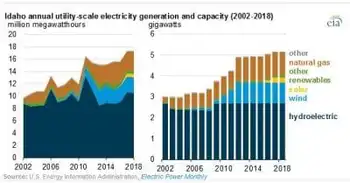
Idaho gets vast majority of electricity from renewables, almost half from hydropower
Idaho Renewable Energy 2018 saw over 80% in-state utility-scale power from hydropower, wind, solar, biomass,…
View more

California’s Solar Power Cost Shift: A Misguided Policy Threatening Energy Equity
California Rooftop Solar Cost Shift examines PG&E rate hikes, net metering changes, and utility infrastructure…
View more
Sign Up for Electricity Forum’s Newsletter
Stay informed with our FREE Newsletter — get the latest news, breakthrough technologies, and expert insights, delivered straight to your inbox.
Electricity Today T&D Magazine Subscribe for FREE

Stay informed with the latest T&D policies and technologies.
- Timely insights from industry experts
- Practical solutions T&D engineers
- Free access to every issue
