NFPA 70E Training
Our customized live online or in‑person group training can be delivered to your staff at your location.

- Live Online
- 6 hours Instructor-led
- Group Training Available
Regular Price:
$199
Coupon Price:
$149
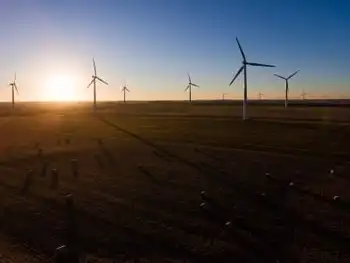
Environmentalists say dozens of turbines that rise 100 metres over wheat fields and herds of sheep represent the future of wind energy - and a model for overcoming the shortcomings that have kept wind from threatening the dominance of fossil fuels.
The High Winds Energy Center, completed in December 2003 in the rolling hills between San Francisco and Sacramento, features turbines that can swivel with the direction of the wind, produce energy even if the wind is blowing less than 13 kilometres per hour and generate 20 times as much energy as earlier machines.
This new wind system, along with similar ones being built elsewhere, promises to produce electricity at competitive prices - all without disturbing surrounding farms and wildlife, two of the obstacles for wind power today.
The 90 turbines at High Winds can generate 162 megawatts of electricity, enough to power about 75,000 homes, according to Florida-based FPL Energy, which owns and operates High Winds along with 30 other wind facilities in 10 states.
"This is the future of wind power," said Ralph Cavanagh, energy program director for the Natural Resources Defense Council. "The wind farm is becoming a productive part of the local community. It's not an interloper that threatens them."
Environmentalists have championed wind power for decades because wind is a free, renewable, non-polluting resource.
But since the first large wind facilities were built in the early 1980s, they have run into technological, economic and political barriers. Early versions didn't produce electricity efficiently enough to compete with oil, coal and natural gas. Communities complained that small forests of turbines marred the landscape, and environmentalists fretted that the blades were killing birds.
The new wind farm, in the Montezuma Hills north of the Sacramento River, has overcome such issues, environmentalists say.
High Winds' turbines are taller, more powerful and more efficient than older turbines, which means they can generate more energy with fewer machines. Each turbine generates 1.8 megawatts.
On a recent morning, the towering turbines' 38-metre blades turned steadily, with little noise, in wind of about 16 km/h.
Many wind farms built in the 1980s are retiring old machines and replacing them with newer, more efficient models similar to those at High Winds, whose turbines were developed by Denmark-based Vestas Wind Systems.
High Winds hasn't run into the kind of opposition plaguing other wind energy projects, such as the offshore towers proposed near Massachusetts' Cape Cod, where residents worry that 40-storey turbines would harm ocean views, seabirds and tourism.
In fact, landowners in the agricultural Montezuma Hills welcome the extra income - FPL pays between $2,500 and $4,000 US a year to lease the space for each turbine, and the surrounding land can still be used raise animals or grow crops.
Birds Landing farmer Ian Anderson calls the project "good for society."
"It's more difficult to farm around (the turbines and access roads), but it's not overwhelming. It's doable," he said. "We're still farming the same as before the wind generators came in."
And unlike the wind farm in the Altamont Pass east of San Francisco, where smaller, low-power turbine blades have killed an estimated 22,000 birds, High Winds' turbines rotate relatively slowly so few birds get caught.
Projects like High Winds have benefited from government incentives such as federal tax credits and state rules requiring utilities to increase their use of renewable energy sources.
Environmentalists hope incentives and improved technology will boost wind from its status as a minor player in the U.S. energy markets.
Even in California, which leads the United States in wind power, less than two per cent of the state's electricity came from wind in 2002, according to the California Energy Commission.
"With improvements in technology, wind power is becoming cost-competitive with any other form of electrical generation," said Jan Johnson, a spokeswoman for PPM Energy, an energy wholesaler that has already sold two-thirds of High Winds' output to cities including Anaheim, Pasadena, Glendale and Sacramento.
"If you have a choice between any form of electrical generation," she added, "are you going to choose one that generates greenhouse gases, or wind power?"
Related News
Two huge wind farms boost investment in America’s heartland
MidAmerican Energy Wind XI expands Iowa wind power with the Beaver Creek and Prairie farms,…
View more

Trump unveils landmark rewrite of NEPA rules
Trump NEPA Overhaul streamlines environmental reviews, tightening 'reasonably foreseeable' effects, curbing cumulative impacts, codifying CEQ…
View more

Affordable, safe' nuclear power is key to reaching Canada's climate goals: federal minister
Canada Nuclear Power Expansion highlights SMRs, clean energy, net-zero targets, and robust regulation to deliver…
View more
Indian government takes steps to get nuclear back on track
India Nuclear Generation Shortfall highlights missed five-year plan targets due to uranium fuel scarcity, commissioning…
View more
A tenth of all electricity is lost in the grid - superconducting cables can help
High-Temperature Superconducting Cables enable lossless, high-voltage, underground transmission for grid modernization, linking renewable energy to…
View more
TC Energy confirms Ontario pumped storage project is advancing
Ontario Pumped Storage advances as Ontario's largest energy storage project, delivering clean electricity, long-duration capacity,…
View more
Sign Up for Electricity Forum’s Newsletter
Stay informed with our FREE Newsletter — get the latest news, breakthrough technologies, and expert insights, delivered straight to your inbox.
Electricity Today T&D Magazine Subscribe for FREE

Stay informed with the latest T&D policies and technologies.
- Timely insights from industry experts
- Practical solutions T&D engineers
- Free access to every issue
