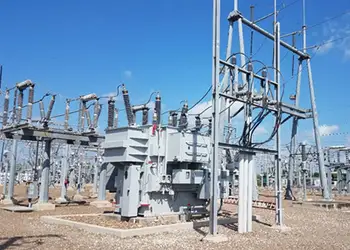
Substation Relay Protection Training
Our customized live online or in‑person group training can be delivered to your staff at your location.
- Live Online
- 12 hours Instructor-led
- Group Training Available
Regular Price:
$699
Coupon Price:
$599
Getting electricity from the sun in Ontario is expected to be cost-competitive with conventional forms of grid power by 2020, though some experts at Canada's premier solar technologies event say the crossover point could come much earlier.
Andrew Kinross, a director with Burlington, Mass.-based Navigant Consulting, told conference attendees today that utility-scale solar photovoltaic projects could reach "grid parity" without subsidies between 2020 and 2023 if fossil fuel prices increase as expected and if, under an emissions trading regime, carbon dioxide is priced at $70 per tonne.
New advancements in solar technologies, particularly high-volume thin film manufacturing, also promise to dramatically lower the cost of making solar modules. In fact, the technology is improving so rapidly that some manufacturers in the audience told the Toronto Star that grid parity could come by 2015 based on the amount of sun Ontario gets over the course of a year - and sooner in sunnier jurisdictions.
Until then, however, Kinross said the industry is relying on government subsidies to kick-start deployment and stimulate job creation, much as subsidies have been used to boost investment in the nuclear and fossil-fuels industries.
"There would be no solar in the world if it were not for subsidies today," said Kinross.
The Canadian solar power market is in its infancy, he said, pointing out that in 2007 the market represented less than half of 1 per cent of the global market (only 13.3 megawatts of solar PV panels were shipped last year).
The top market was Germany at 47 per cent, followed by Spain at 18 per cent and the United States at 10 per cent.
But the Canadian market shows huge potential, he said. More than 500 megawatts worth of solar projects are in the pipeline, a backlog that would have represented 17 per cent of the global market had product been shipped and installed last year.
The recent fall in the Canadian dollar and the higher cost of obtaining debt financing following the global financial crisis will make projects more expensive, said Kinross, but some of this will be offset by an up to 30 per cent drop in the cost of solar modules in 2009.
The challenge of securing financing isn't insurmountable, he said, but it's unlikely to come from Canada's risk-averse banking community, which continues to shun home grown solar projects.
A joint venture between Toronto-based SkyPower and Baltimore-based Sun Edison LLC announced that it raised $80 million in financing from German bank Nord/LB for its "First Light" solar farm in Lennox and Addington County.
Kinross said he doesn't understand why Canadian banks aren't jumping into a market considered low risk by foreign banks. "Why it takes a German bank to fund an Ontario project, it just doesn't quite make sense to me," he said.
Energy and Infrastructure Minister George Smitherman said yesterday that the province is working on new rules and legislation that would make the Ontario solar market more attractive for investors and companies looking to establish manufacturing and create jobs in the province.
Smitherman asked the record 625 people gathered at the Canadian Solar Industries Association two-day annual conference to be patient. "You're going to be very happy with the approach we're going to take."
A handful of solar companies at the conference that are considering setting up manufacturing operations in Toronto and surrounding communities told the Star they're encouraged but are waiting for the government to back up rhetoric with solid policy.
Related News

Hydro One deal to buy Avista receives U.S. antitrust clearance
Hydro One-Avista Acquisition secures U.S. antitrust clearance under Hart-Scott-Rodino, pending approvals from state utility commissions,…
View more

Seattle City Light's Initiative Helps Over 93,000 Customers Reduce Electricity Bills
Seattle City Light Energy Efficiency Programs help 93,000 residents cut bills with rebates, home energy…
View more

Canada Invests Over $960-Million in Renewable Energy and Grid Modernization Projects
Smart Renewables and Electrification Pathways Program enables clean energy and grid modernization across Canada, funding…
View more
Russian Strikes Threaten Ukraine's Power Grid
Ukraine Power Grid Attacks intensify as missile and drone strikes hit substations and power plants,…
View more
France hopes to keep Brussels sweet with new electricity pricing scheme
France Electricity Pricing Mechanism aligns with EU rules, leveraging nuclear energy and EDF profits, avoiding…
View more
Federal Government announces funding for Manitoba-Saskatchewan power line
Birtle Transmission Line connects Manitoba Hydro to SaskPower, enabling 215 MW of clean hydroelectricity, improving…
View more
Sign Up for Electricity Forum’s Newsletter
Stay informed with our FREE Newsletter — get the latest news, breakthrough technologies, and expert insights, delivered straight to your inbox.
Electricity Today T&D Magazine Subscribe for FREE

Stay informed with the latest T&D policies and technologies.
- Timely insights from industry experts
- Practical solutions T&D engineers
- Free access to every issue
