Protective Relay Training - Basic
Our customized live online or in‑person group training can be delivered to your staff at your location.

- Live Online
- 12 hours Instructor-led
- Group Training Available
Regular Price:
$699
Coupon Price:
$599
World demand for all forms of energy is expected to grow by 54 percent over the next two decades, with oil consumption alone jumping by 40 million barrels a day, the U.S. government said recently.
The U.S. Energy Information Administration's long-term forecast to the year 2025 projects the strongest growth in energy use from developing countries, especially China and India, where buoyant economies will boost demand.
Energy use in developing countries is forecast to soar by 91 percent over the next two decades, while rising 33 percent in industrialized nations.
"Generally, the nations of the industrialized world can be characterized as mature energy consumers with comparatively slow population growth," said the EIA, the Energy Department's analytical arm.
These countries are also shifting from energy-intensive manufacturing to service industries, which means slower growth in energy use, it said.
World oil demand is forecast to rise from 81 million barrels per day (bpd) this year to 121 million bpd in 2025, with the United States, China and the rest of developing Asia soaking up almost 60 percent of those extra barrels, EIA said.
"Over the past several decades, oil has been the world's foremost source of primary energy consumption, and it is expected to remain in that position," the agency said. To meet that demand, global oil production capacity would have to rise by 44 million bpd over current levels, it said.
OPEC is expected to be the major supplier of the extra oil, with the cartel's production at 56 million bpd in 2025 compared to 27 million bpd this year.
Additional non-OPEC barrels will also come from offshore wells in the Caspian Sea, Latin America and West Africa. Average annual oil prices are expected to decline after this year to $25 a barrel in inflation-adjusted 2002 dollars, and then rise slowly to $27 in 2025, which would be $51 a barrel in nominal dollars, the agency said.
Other highlights of EIA long-term energy forecast include:
* Natural gas is the fastest growing primary energy source through 2025, increasing 67 percent to 151 trillion cubic feet a year. That would be down from the 176 Tcf forecast in last year's report, because of slower projected declines in nuclear power generation and concerns about long-term gas production.
* World electricity demand will almost double by 2025, growing 3.5 percent a year in developing countries from newly purchased home appliances and air conditioning.
* Coal use will grow by 1.5 percent a year, with demand increases in all regions expect for Western Europe and the former Soviet states in Eastern Europe, where coal will be displaced by natural gas.
* Nuclear power use will increase because of higher generating capacity rates for existing plants and fewer facilities will be retired. In the developing world, consumption of electricity from nuclear power increases by an average 4.1 percent a year during the forecast period.
* Carbon dioxide emissions will rise from 23.9 billion metric tonnes in 2001 to 27.7 billion tonnes in 2010 and 37.1 billion tonnes in 2025. The developing world will account for 61 percent of the increase because of reliance on coal and other fossil fuels.
Related News
Norway Considers Curbing Electricity Exports to Avoid Shortages
Norway Electricity Export Limits weigh hydro reservoirs, energy security, EU-UK interconnectors, and record power prices…
View more
Competition in Electricity Has Been Good for Consumers and Good for the Environment
Electricity Market Competition drives lower wholesale prices, stable retail rates, better grid reliability, and faster…
View more

Egypt, Eni ink MoU on hydrogen production projects
Egypt-ENI Hydrogen MoU outlines joint feasibility studies for green and blue hydrogen using renewable energy,…
View more

A tenth of all electricity is lost in the grid - superconducting cables can help
High-Temperature Superconducting Cables enable lossless, high-voltage, underground transmission for grid modernization, linking renewable energy to…
View more
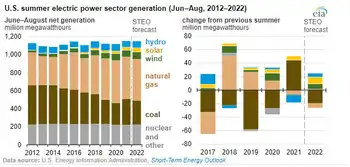
EIA expects solar and wind to be larger sources of U.S. electricity generation this summer
US Summer Electricity Outlook 2022 projects rising renewable energy generation as utility-scale solar and wind…
View more
U.S. Grid overseer issues warning on Coronavirus
NERC COVID-19 Grid Security Alert urges utilities to update business continuity plans, assess supply chain…
View more
Sign Up for Electricity Forum’s Newsletter
Stay informed with our FREE Newsletter — get the latest news, breakthrough technologies, and expert insights, delivered straight to your inbox.
Electricity Today T&D Magazine Subscribe for FREE

Stay informed with the latest T&D policies and technologies.
- Timely insights from industry experts
- Practical solutions T&D engineers
- Free access to every issue

