





Grounding and Bonding Training - Our 12 Hour Live Online instructor-led training course is founded on the Canadian Electrical Code.
This Grounding and Bonding Training course is founded on the CECode and is designed to give you the correct information you need to design, install and maintain effective electrical grounding systems in industrial, commercial and institutional power systems.
One of the most important AND least understood sections of the CECode is the section on Electrical Grounding.
This Electrical Grounding and Bonding Training course will address all changes on Grounding & Bonding included in the CECode.
This interactive two-day Grounding and Bonding Training course will cover grounding fundamentals, identify which grounding system tests can prevent safety and operational issues at your facilities and details regarding which tests can be conducted while the plant is in operation versus which tests require a shutdown will be discussed.
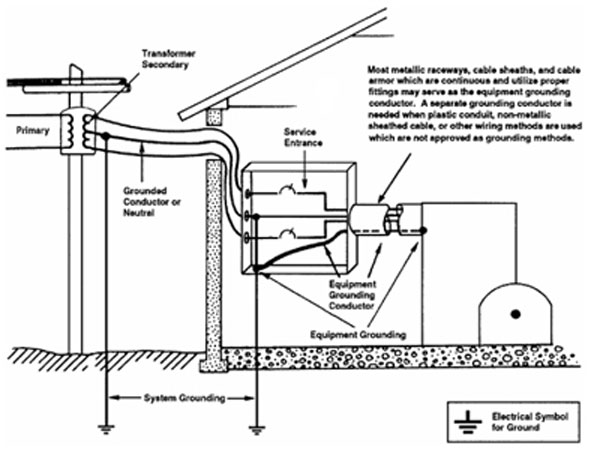
Proper electrical grounding and bonding of equipment helps ensure that the electrical equipment and systems safely remove the possibility of electric shock, by limiting the voltage imposed on electrical equipment and systems from lightning, line surges, unintentional contact with higher-voltage lines, or ground-fault conditions. Proper grounding and bonding is important for personnel protection, as well as for compliance with OSHA 29 CFR 1910.304(g) Grounding.
One of the most important AND least understood sections of the CECode is the section on Electrical Grounding and Bonding. This course is founded on the CECode and is designed to give you the correct information you need to design, install and maintain effective electrical grounding systems in industrial, commercial and institutional power systems. This course will address all changes on Grounding & Bonding included in the CECode. The CECode recognizes materials other than Copper for uses as a Grounding Conductor in ten different articles of the code. It also addresses corrosion issues in new added Subrule. There are new Sub rules on Bonding Conductors that bonds fixed equipment. Some other Sub rules have been amalgamated into a new rule. One of the most important changes has been that the new code does not favor 'water pipe' as a grounding electrode. Some other rules have been modified to require alarm indicator installation to indicate a fault on certain systems. Some other Sections have been changed to be consistent with the rest of the code in particular the Ground Fault Circuit interrupters. Changes have been made to Station Grounding, to meet the maximum permissible Resistance of Station Grounding Electrode. Some of the requirements for driven Ground Rods were deleted, to be consistent with CECode Standard 41.
It has been determined that more than 70 per cent of all electrical problems in industrial, commercial and institutional power systems are due to poor grounding, and bonding errors. Without proper electrical grounding and bonding, sensitive electronic equipment is subjected to destruction of data, erratic equipment operation, and catastrophic damage. This electrical grounding and bonding training course will give participants a comprehensive understanding of practical applications of proper grounding and bonding practices that will comply with the Canadian Electrical Code.
Increase Your Knowledge
Learn About
After Attending, You Will
Without good grounding and bonding, sensitive electronic equipment is subjected to destruction of data, erratic equipment operation, and catastrophic damage. Allen G.W. Segall (IBM Study) determined that 88.5% of all disturbances are caused by transient overvoltage and, therefore, it is of critical importance to know the "state-of-the-art" protection technologies.
Inductive effects of lighting including transients, wiring errors, and code violations cause damages estimated at about $20 billion dollars in the US and Canada each year, based on the following considerations: risk to personnel, equipment replacement cost, repairs cost, and destroyed data. The economics: Loss of sales, Loss of production, Loss of work in progress. The knowledge acquired in this course will enable the participant to apply correct electrical installation procedures according to the CECode, effective cabling and state-of-the-art technologies available for the protection of equipment and circuits. A code violation poses hazards to human life and equipment.
Grounding and Bonding Training
DAY ONE
INDUSTRIAL, COMMERCIAL GROUNDING SYSTEMS
Session 1: Grounding and Bonding Overview
Session 2: Grounding Electrode System
Session 3: System and Circuit Grounding
Session 4: Resistance Grounding
Session 5: Grounding of Generator to Supply Emergency Power
DAY TWO
Session 6: Bonding
Session 7: Renewable- Solar Photovoltaic Systems (PV) and Wind Power System
Session 8: Grounding Computer Rooms/SCADA Systems
Session 9: Electro Magnetic Interference (EMI) on Electronic Circuits
Session 10: Lightning Protection
COURSE SCHEDULE:
Both days:
Start: 10 a.m. Eastern Time
Finish: 4:30 p.m. Eastern Time
The registration fee to attend this live online training course is $699 + GST/HST.
Click Here to download a $100 discount coupon that you can apply toward the regular registration fee and pay only $599 + GST/HST
Register 3 delegates at full price $699, and get a 4th registration FREE!
Successful completion of this course qualifies delegates to receive a certificate of course completion with indicated CEUs.

CEUs are granted by the Engineering Institute of Canada. One CEU is equivalent to 10 professional development hours of instruction.
This course earns 1.2 CEUs.

We can present this Grounding and Bonding Training And The CE Code to your electrical engineering and maintenance staff, tailored to your specific equipment and requirements. We are ready to help design this program for you. Click on the link below to request a FREE quotation.